AI Health Companion
An AI-powered holistic health companion designed for women managing chronic, multi-system conditions.
ROLE
Designer
TEAM
4 Designers
Client
PLATFORM
Android
iOS
TIMELINE
Phase 1
2024
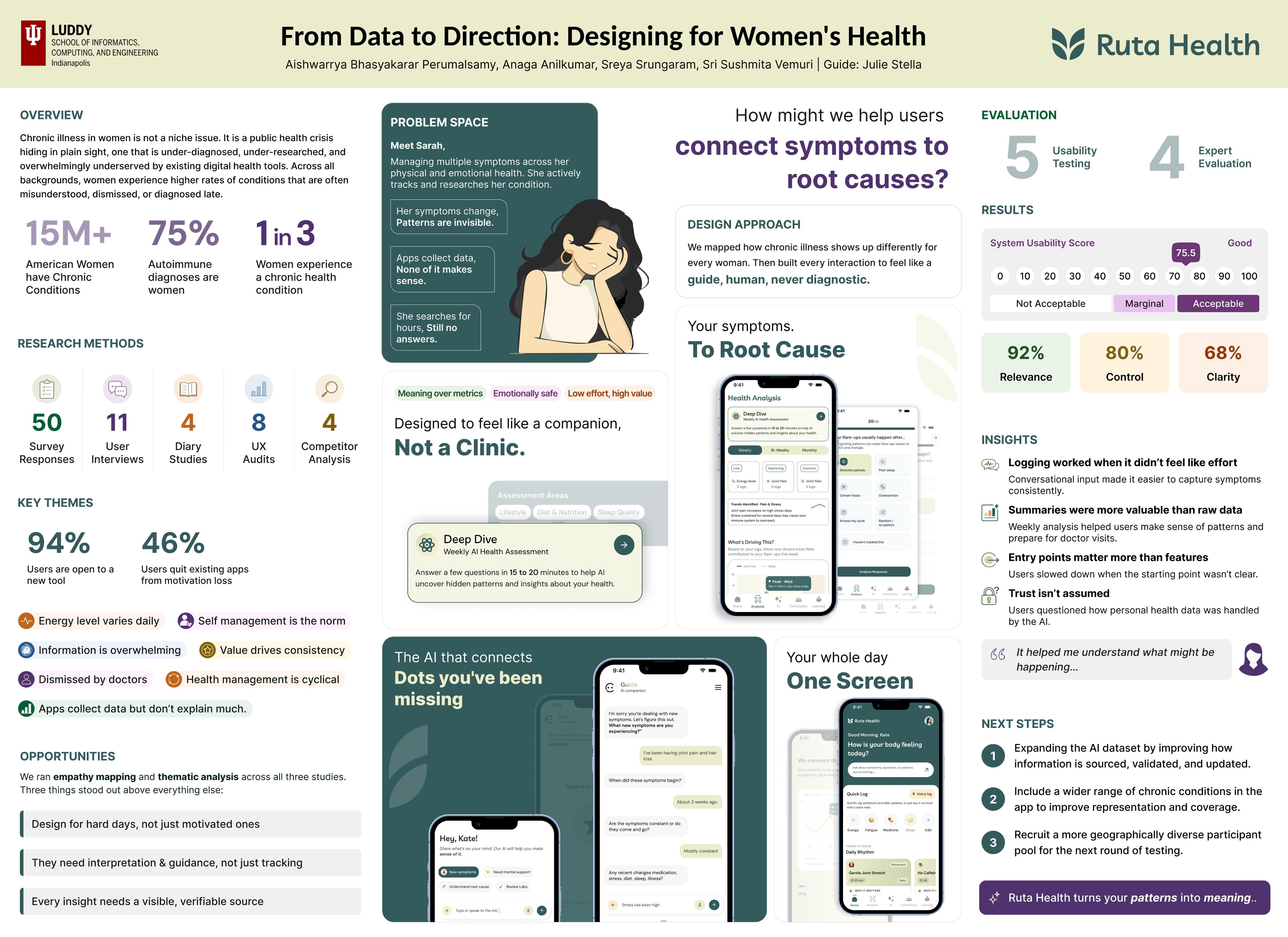
THE SCALE OF THE PROBLEM
M+
%
in
Women are actively managing their health, researching symptoms, trying new tools, visiting specialists. They are doing it alone, against a system that consistently fails them in three ways.
Fragmented care
Doctors dismiss or minimise symptoms as "normal" or "just lose weight."
Information overload
Vast, conflicting, and commercially motivated, impossible to know what to trust.
Meaningless tracking
Apps collect data but generate no understanding. After weeks of logging, users still cannot answer "why".
THE RESEARCH
We spent the first phase listening.
Literature, competitors, and real women navigating chronic conditions every day.
SURVEYS
INTERVIEWS
DIARY STUDIES
COMPETITORS
THEMES
What the research told us to do
Design for hard days, not motivated ones
Health management is cyclical deep engagement on good days, near-complete disengagement on hard ones. Energy level is the single biggest predictor of whether someone uses the app.
Build features that explain, not just collect
Make trust visible, not claimed
Users triangulate between AI tools, doctors, and peer communities to verify anything. Trust must be structural every insight tied to a verifiable source.
Voices from the research
The reframe
We stopped designing a tracker. We started designing a companion, one that helps users understand what's happening, why patterns emerge, and what to do next.
Design principles
Principles that anchored every decision.
Meaning over metrics
Interpreted insights, not raw data dumps. If it can't be explained, it doesn't ship.
Emotionally safe
Supportive, human language. Designed for women who have been dismissed before.
Low effort, high value
Minimal input, high clarity output. Usable on the hardest day, not just the motivated one.
My contribution
How we worked together
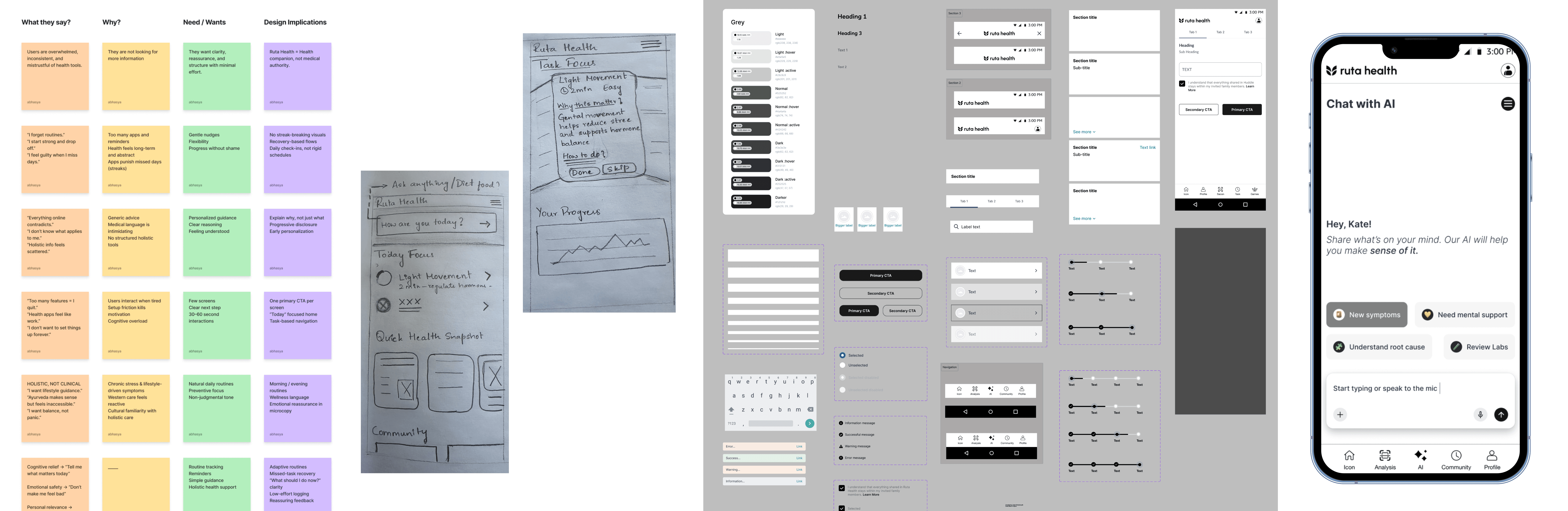
We split the product across four designers. My focus was the foundational layer, the design system everyone built on, the root cause analysis flow, and the first working versions of the home screen and AI chat. Client coordination ran through me throughout the project. Research was a shared effort across all four. Other teammates owned onboarding, learning, and community.
Work moved between hands as it matured, first versions became final versions through collaboration.
THE DECISION
The decisions that shaped the experience
Decision 01
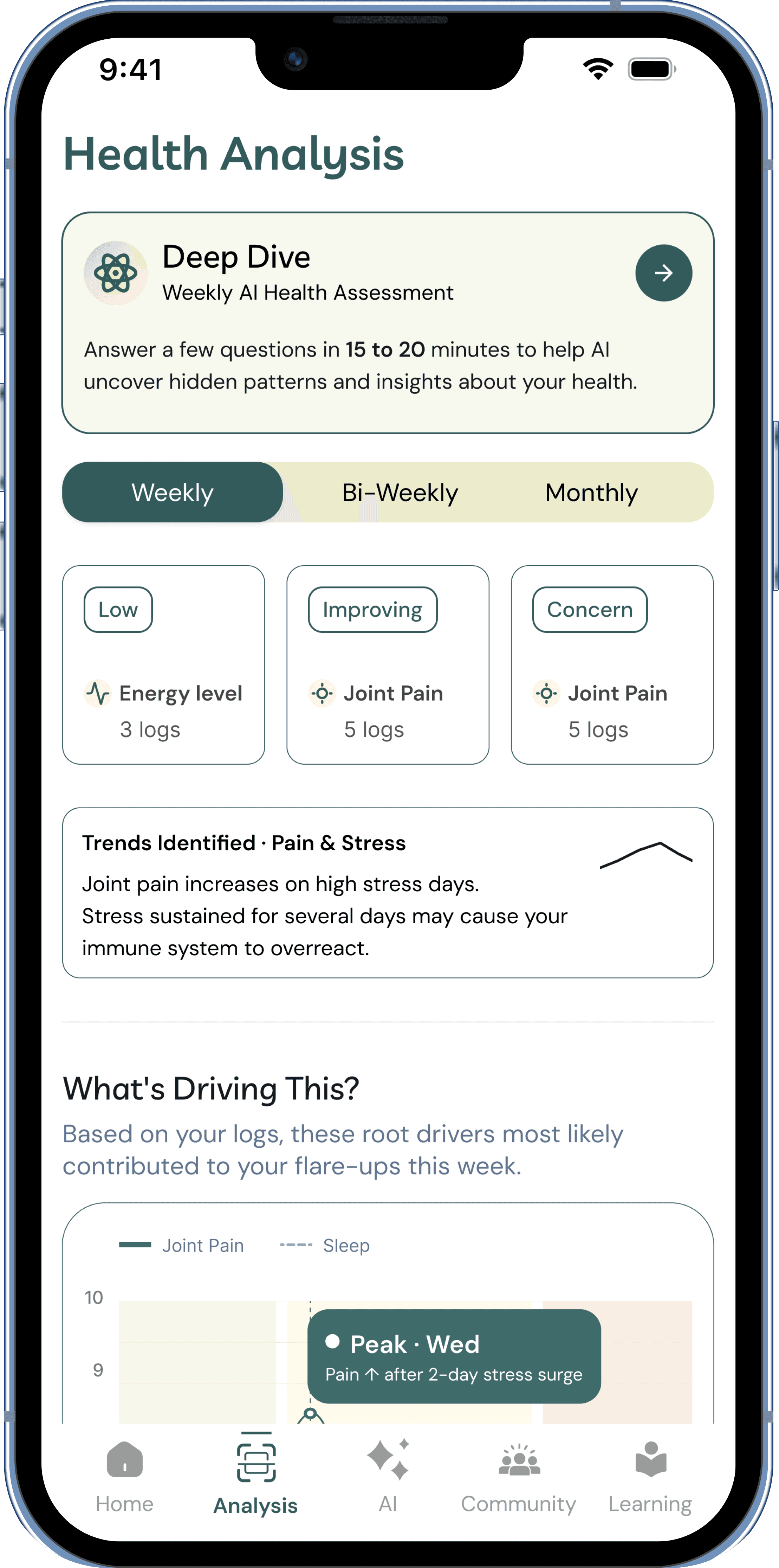
Weekly Deep Dive
High-signal weekly input beats noisy daily tracking.
Every competing app asks 15+ questions every day. Users burn out.
We designed a weekly 15–20 minute structured assessment instead deeper questions, less often, clearer output.
① Structured over daily logging
A weekly assessment, deeper input, less often, clearer output.
② Assessment areas adapt
Lifestyle, diet, sleep, stress, mental health categories adjust based on what the user has been logging that week.
③ Patterns surfaced immediately
Results show trends like "Joint pain increases on high stress days" with a visual graph — not buried in raw data.
Decision 02
AI as companion, not assistant
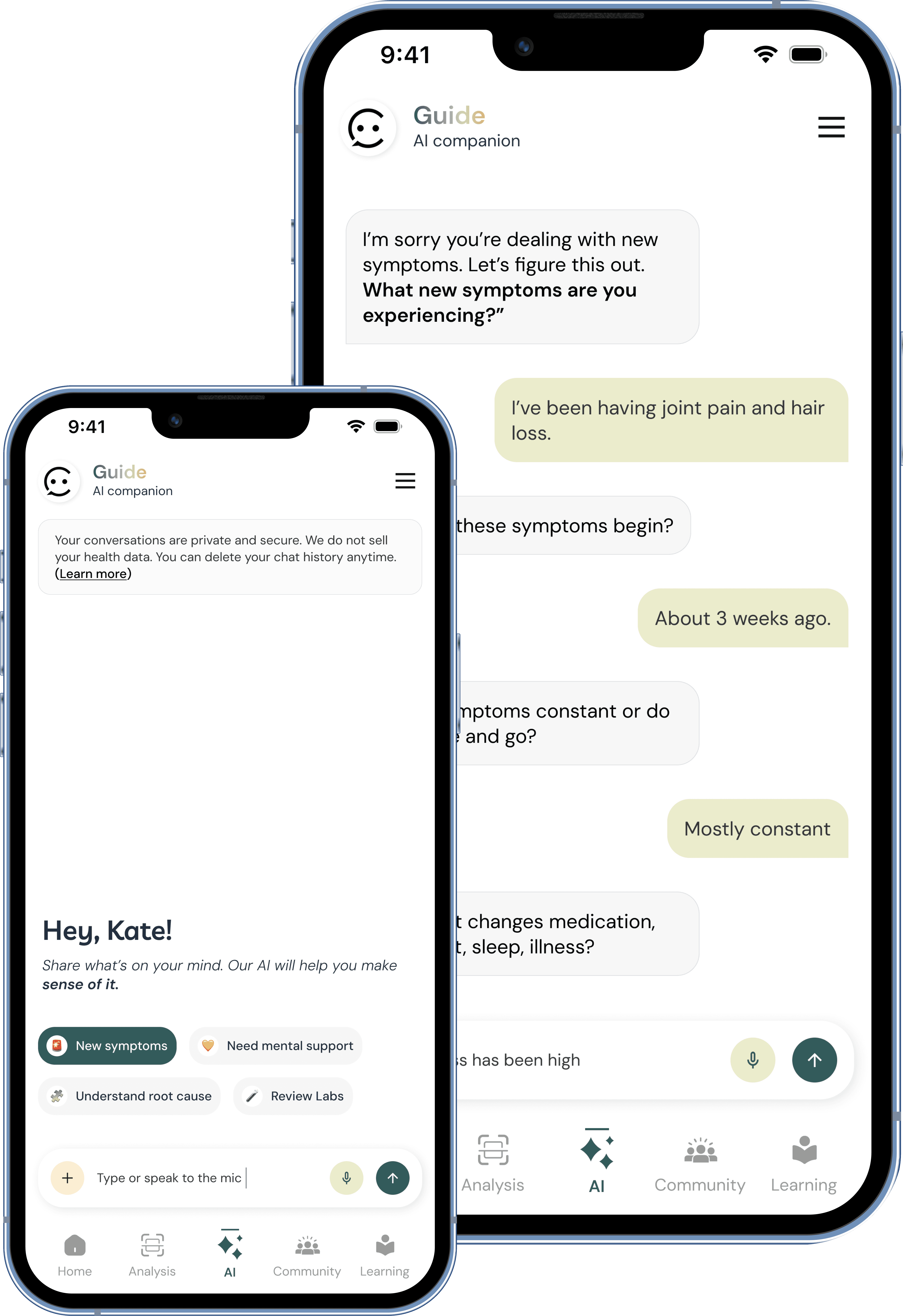
The AI asks the next question. It doesn't wait for yours.
Most health chatbots ask users to describe everything in one shot. I designed an adaptive flow where the AI asks a single question at a time, the way a thoughtful friend would be and builds context across the conversation.
① Privacy first opening
The first message is not a question, it's a reassurance. "Your conversations are private and secure. You can delete your chat history anytime."
② One question at a time
The AI asks a single follow-up, not a form. "What new symptoms?" then "When did they begin?" - the way a thoughtful person would listen.
③ Sourced explanation not opinions
Every insight links to medical sources — American Psychological Association, Journal of Autoimmunity. The AI shows its work, not just its answer.
Decision 03
Root cause, not symptom summary
Connect the dots users have been missing.
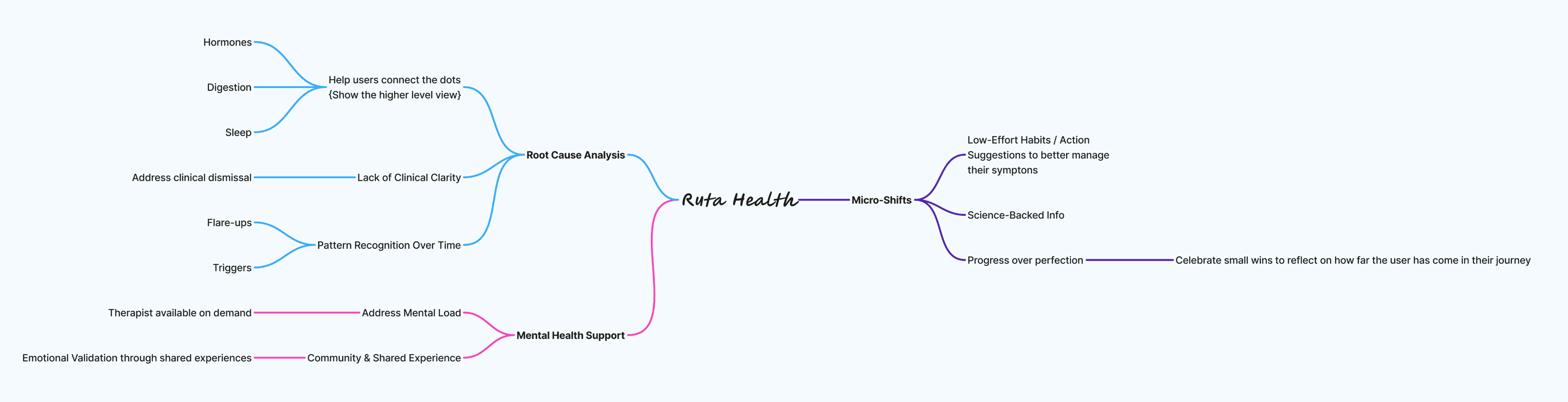
The analysis section doesn't just summarise what was logged. It surfaces probable drivers stress, sleep, food, hormones with confidence levels and verifiable sources.
① Patterns, not raw data
"Your flare-ups might be linked to stress and blood sugar changes." A narrative the user can take to their doctor — not a spreadsheet.
② Confidence levels shown honestly
Each finding shows "Moderate" or "Strong", never claims certainty. Designed to inform, not diagnose.
③ Actionable next steps built in
Light Movement (5 - 10 min, Easy) and Meditation (10 min) appear directly below the pattern not in a separate section the user has to find.
Onboarding
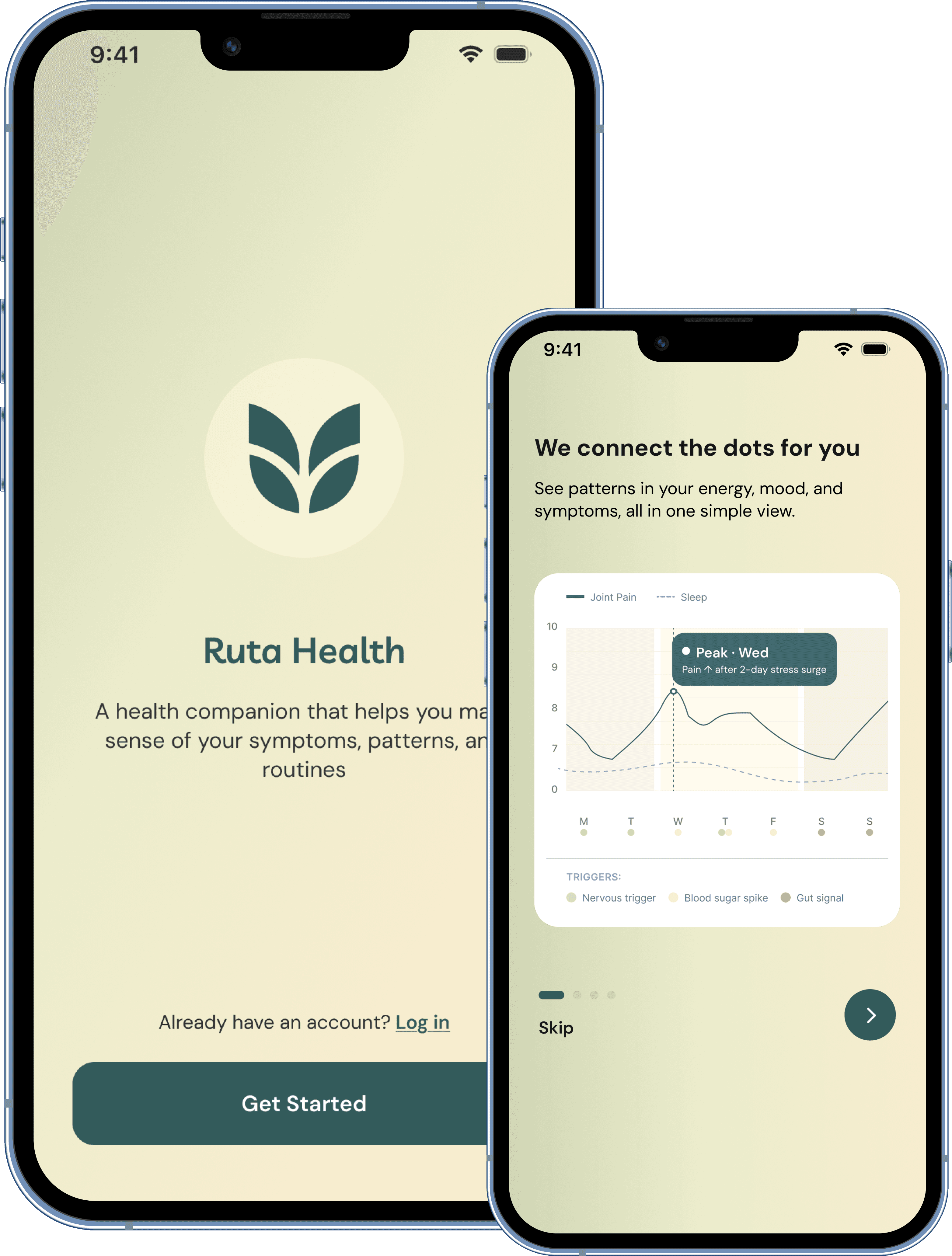
The product earns trust before it asks for data. "A companion, not a diagnosis tool" and "You own your health data" appear before a single input is requested. From there, five screens - age, conditions, top concerns, medications, get the user personalised and inside the product in under two minutes. Selecting a condition like Hashimoto's or Lupus changes what the app tracks, asks, and recommends from day one.
Home · Learning · Community
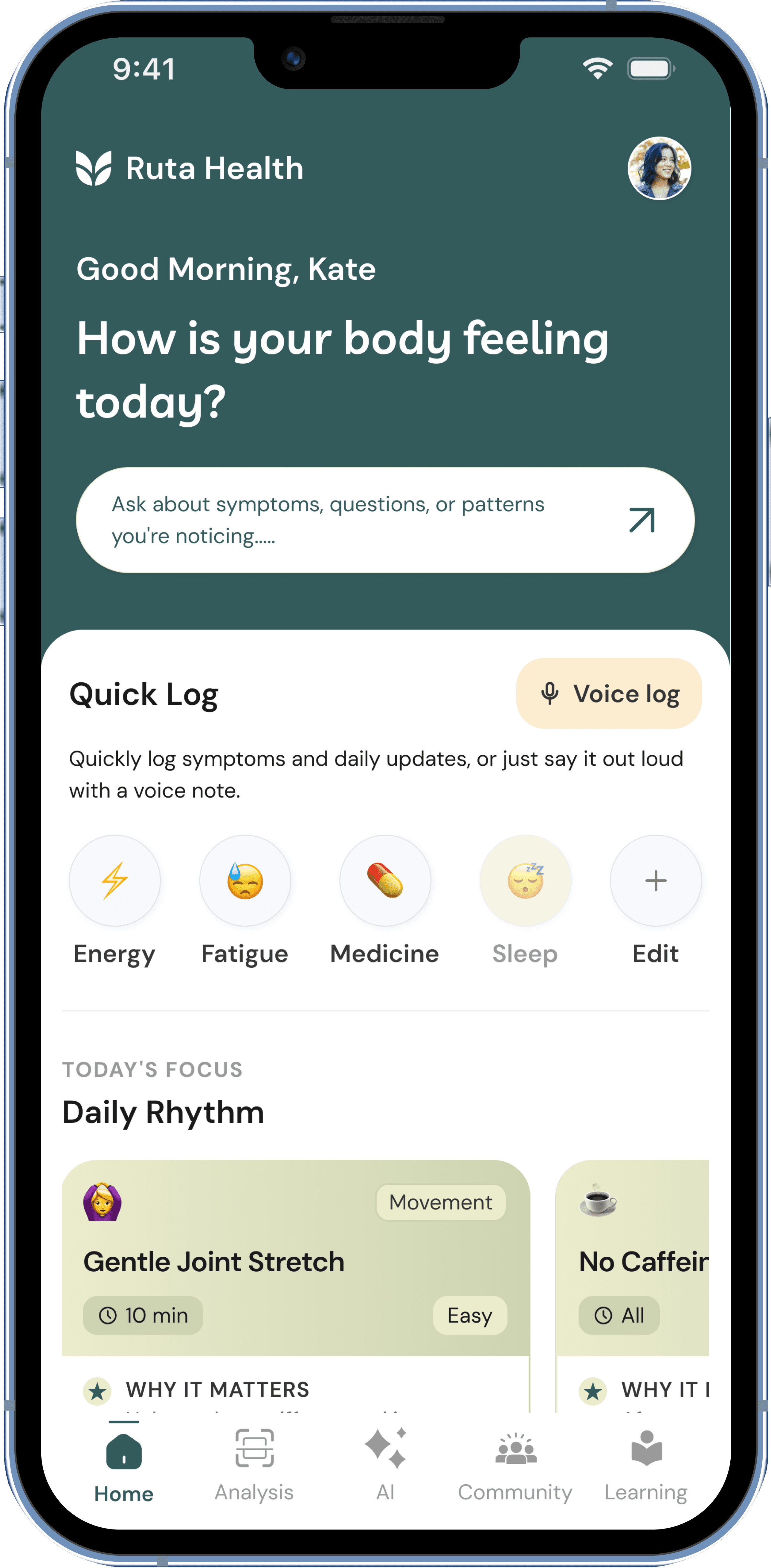
The home screen holds everything a user needs for the day - quick log, daily rhythm tasks, and pattern insights. Learning isn't a generic content library, articles and resources are suggested based on patterns detected in the user's own logs. Community offers groups, trending posts, and peer support, but sharing personal health data is never required. Participation is optional, not a feature gate.
VALIDATION
We tested with real women. Then tested again.
SYSTEM USABILITY SCORE
75.5
/100
Good
5 moderated sessions
Think-aloud + SUS
%
Relevance
users found suggestions highly relevant
%
Control
%
Clarity
WHAT USERS SAID
Logging worked when it didn't feel like effort
Conversational input made it easier to capture symptoms consistently.
Summaries were more valuable than raw data
Weekly analysis helped users make sense of patterns and prepare for doctor visits.
Trust isn't assumed
PROTECTED
NDA
Behind the intelligence layer
READ
🔒
AI system design details abstracted for client confidentiality
What I learned
Designing for AI is designing for trust.
Four years at Amazon taught me how to design for scale. This project taught me how to design for uncertainty, the kind users carry into every interaction with a health product.
The hardest part was not the AI. It was designing the moments between the AI and the user, the pauses, the disclosures, the way a single word in a chat bubble can either reassure or alienate someone who has already been dismissed by doctors.
That gap between intelligence and empathy is where I want to keep working.
Meet the Team