Design Sprint
Designing trust into a loan flow for first-time borrowers.
A cross-functional sprint with 20 people to make returning
a product feel as trusted as buying one.
ROLE
TEAM
PLATFORM
Android
iOS
TIMELINE
5 days
2023
Day 1
Understanding
Day 2
Unpacking
Day 3
Ideation
Day 5
Testing
Day 4
Prototype
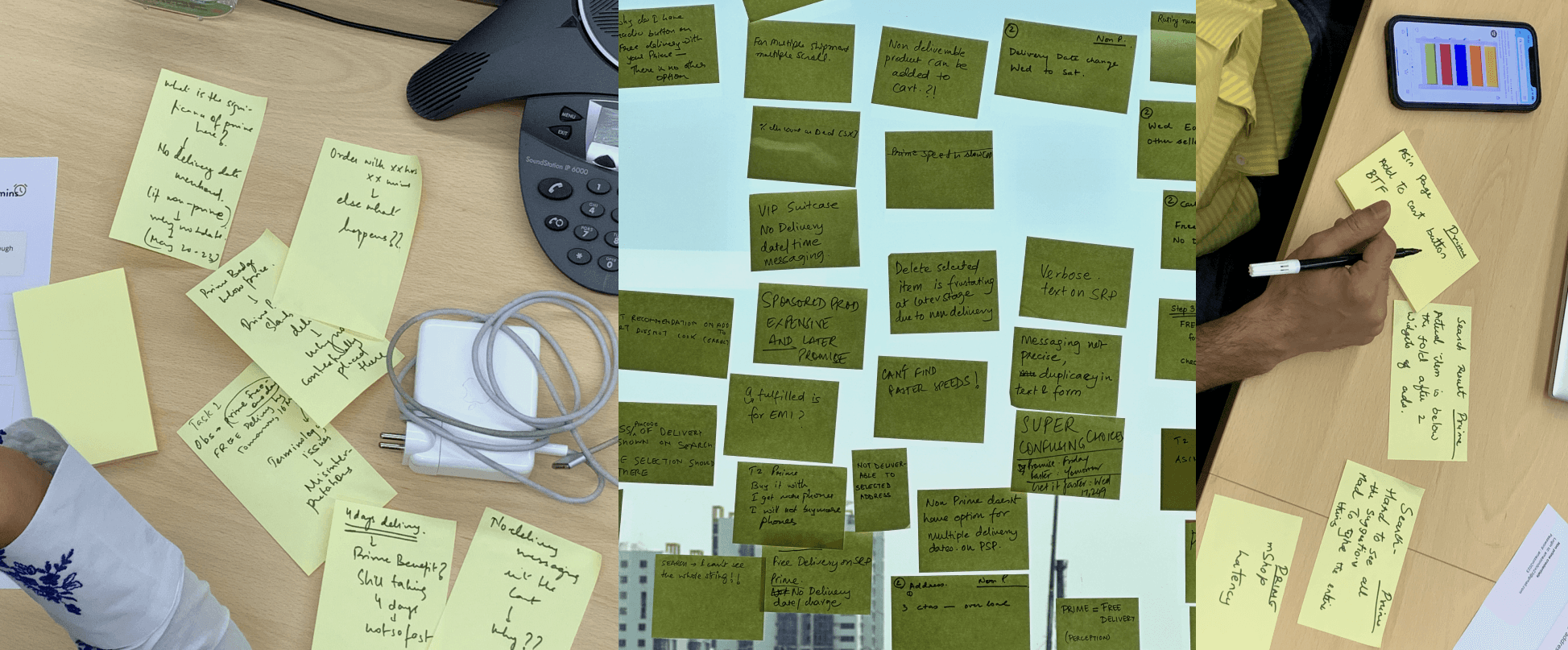
WHY THIS SPRINT
Amazon India's return experience was generating thousands of support tickets every month
Users were not just confused they were frustrated. Policies were buried. Terminology was inconsistent.
Status tracking was opaque. The gap between requesting a return and getting money back felt like a void the product had never designed for.
20 people - managers, designers, developers, were pulled off their regular work for 5 days.
That only happens when the problem is costing trust at scale.
Questions Raised
01
How can we simplify and clarify the return policy?
02
Are terms like 'replacement' and 'exchange' confusing customers?
03
Are we clearly communicating item status during returns?
04
Is the return initiation flow seamless enough?
05
How can we reduce fraudulent returns without punishing honest users?
Quick Preview Before We Dive Deeper
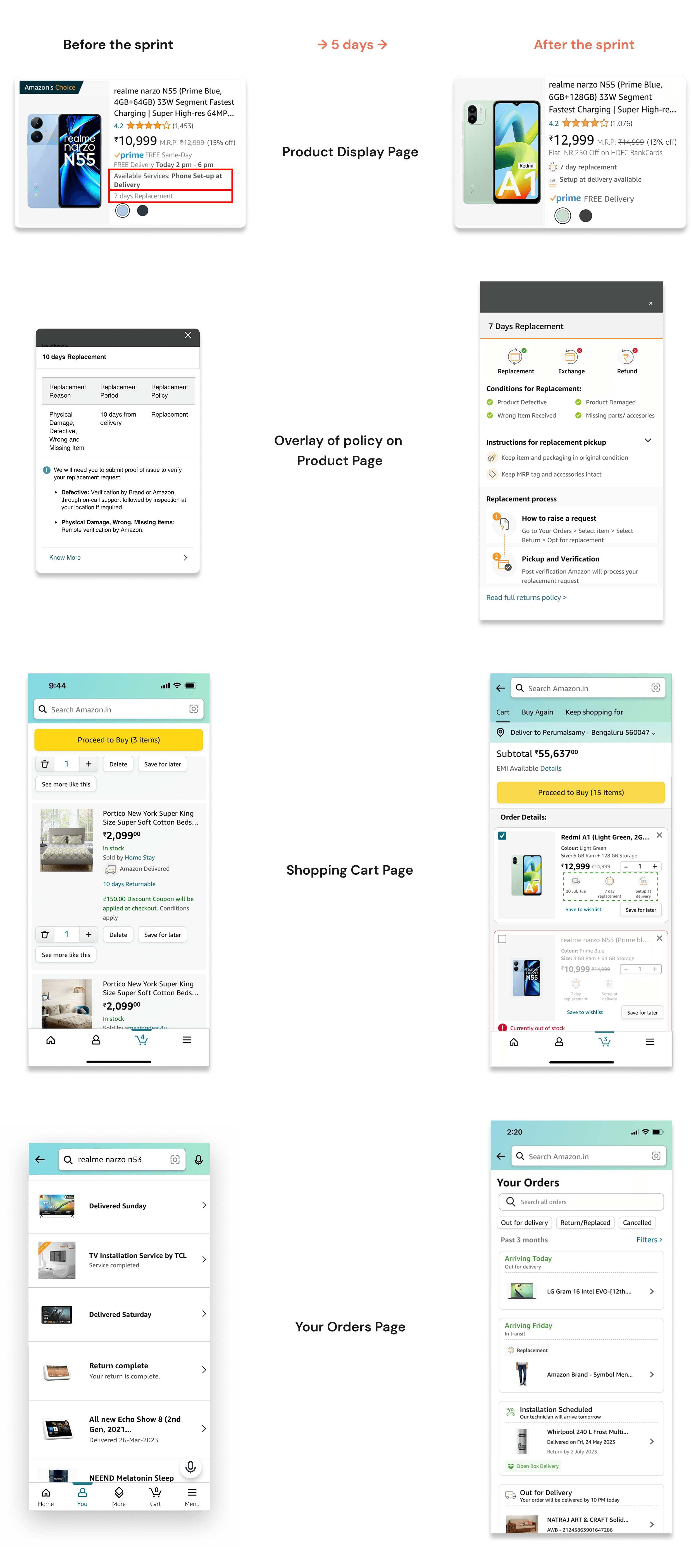
DAY 1 & 2 : WHAT WE DISCOVERED
We talked to real users. Shadowed support staff.
One session changed everything.
A Tier 2 customer scrolling through three return screens, unable to tell if their request had even been received. That moment shaped every decision that followed.
"What's the difference between exchange and replacement? I don't understand."
Customer, Tier 2 city
"Why is the service center required now?
This wasn't clear before ordering."
Customer, Tier 1 city
SIX PROBLEM AREAS SURFACED ACROSS DAY 1 & DAY 2
Difficult access
Users could not find the returns section in under 30 seconds
Lengthy processes
Multiple steps, unclear progress, no sense of how long it would take
Lack of transparency
No updates between 'request received' and 'refund processed'
Refund delays
Manual processing slowed resolutions, users waited without knowing why
Confusing terms
Product Exchange vs Replacement vs Refund, nobody could explain the difference
Service center gaps
Limited visibility on self-repair and service center options
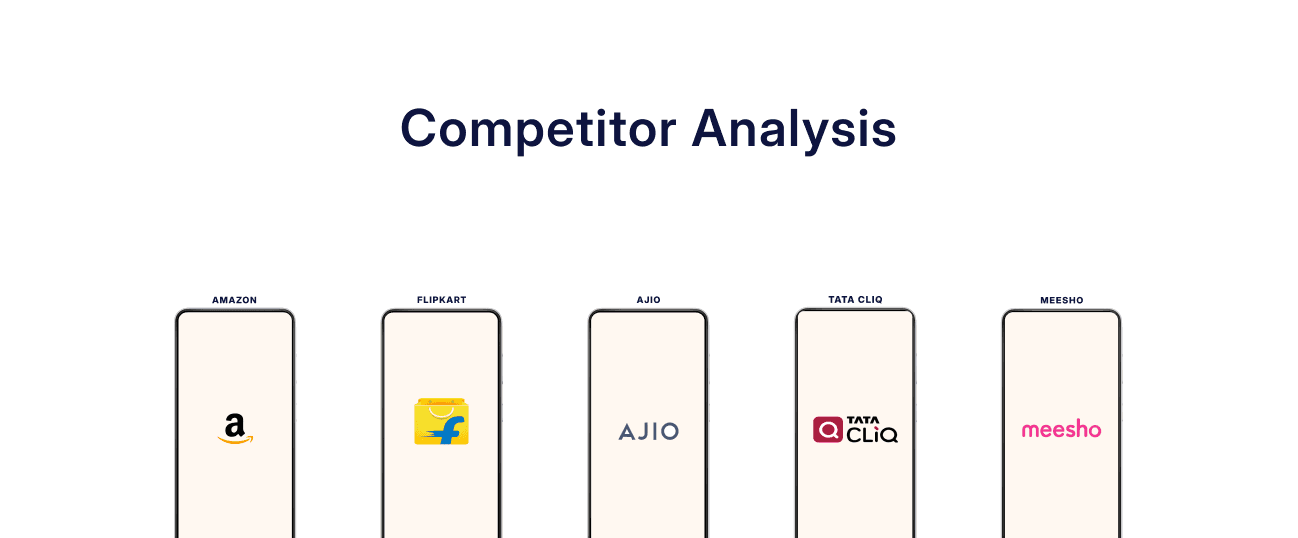
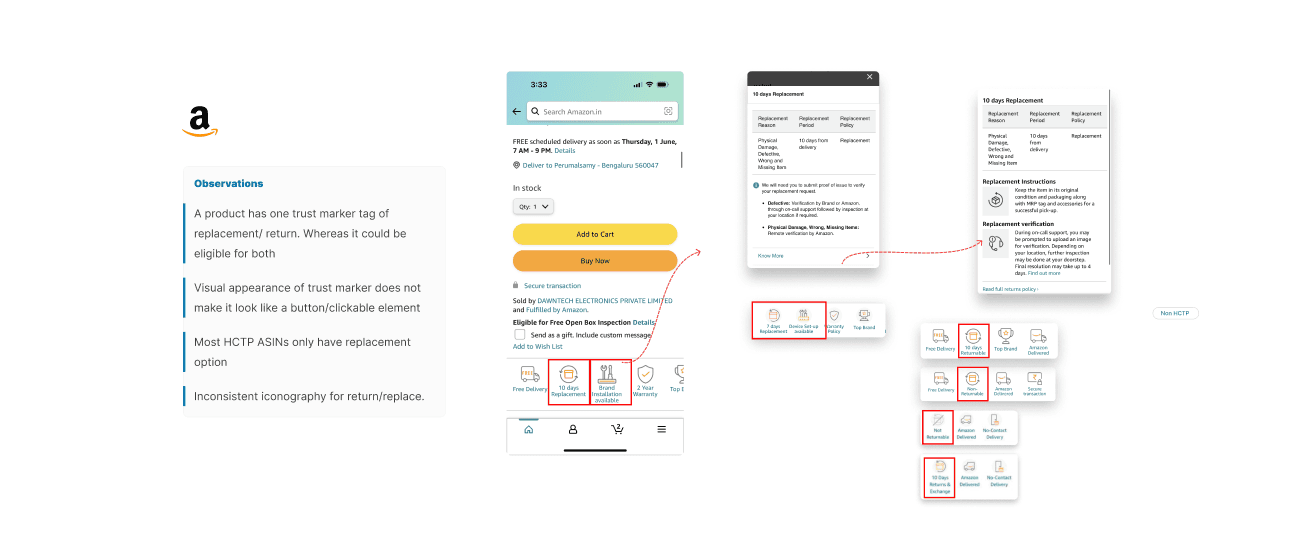
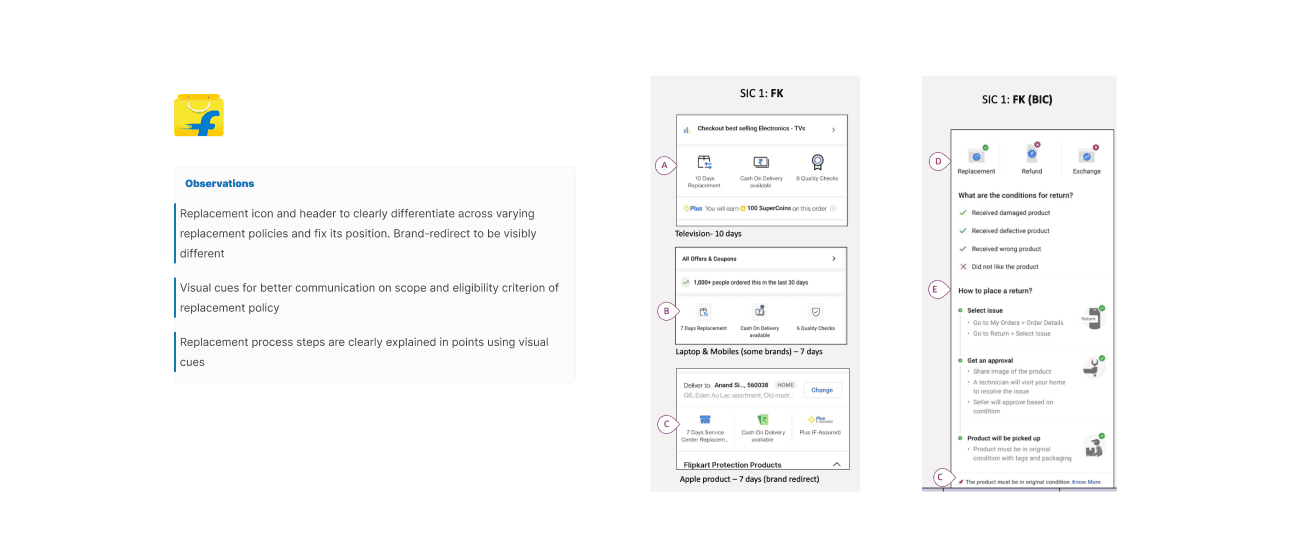
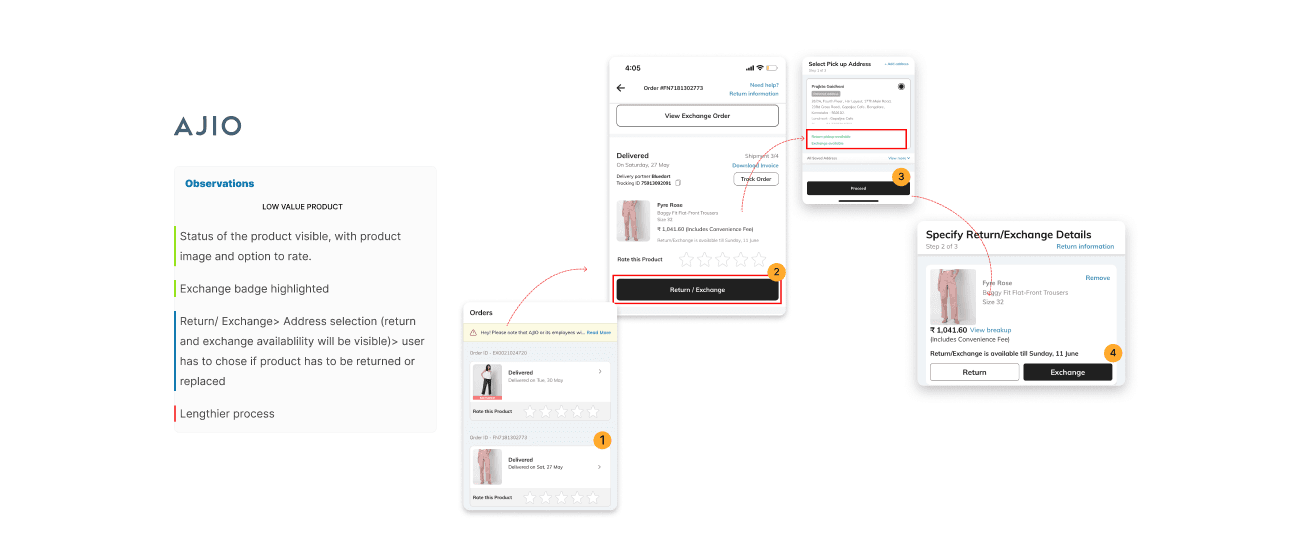
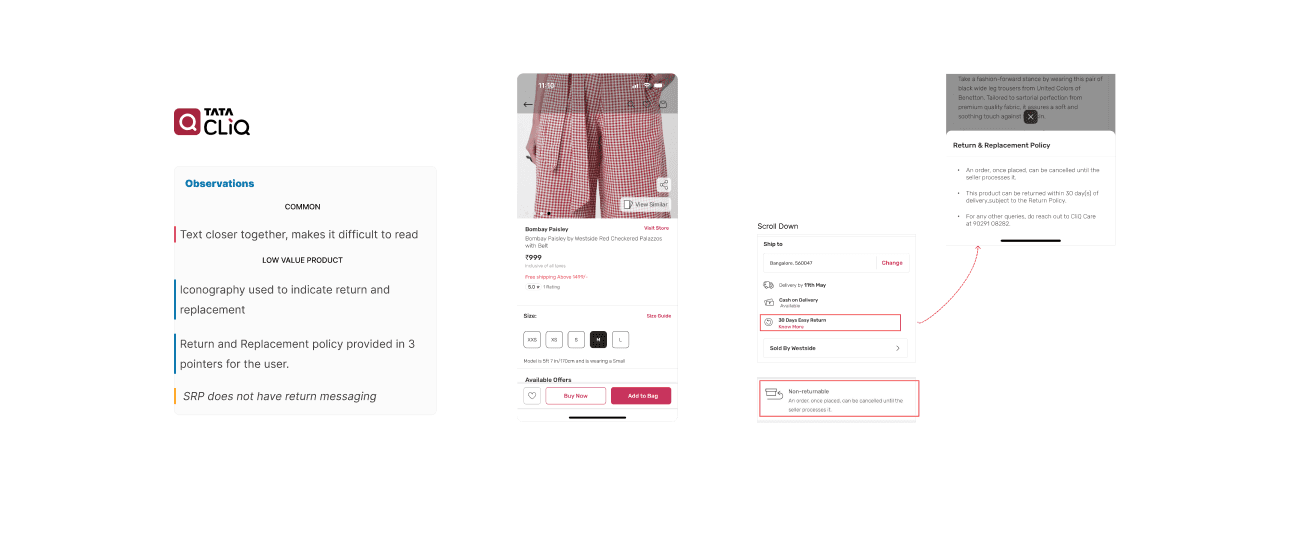
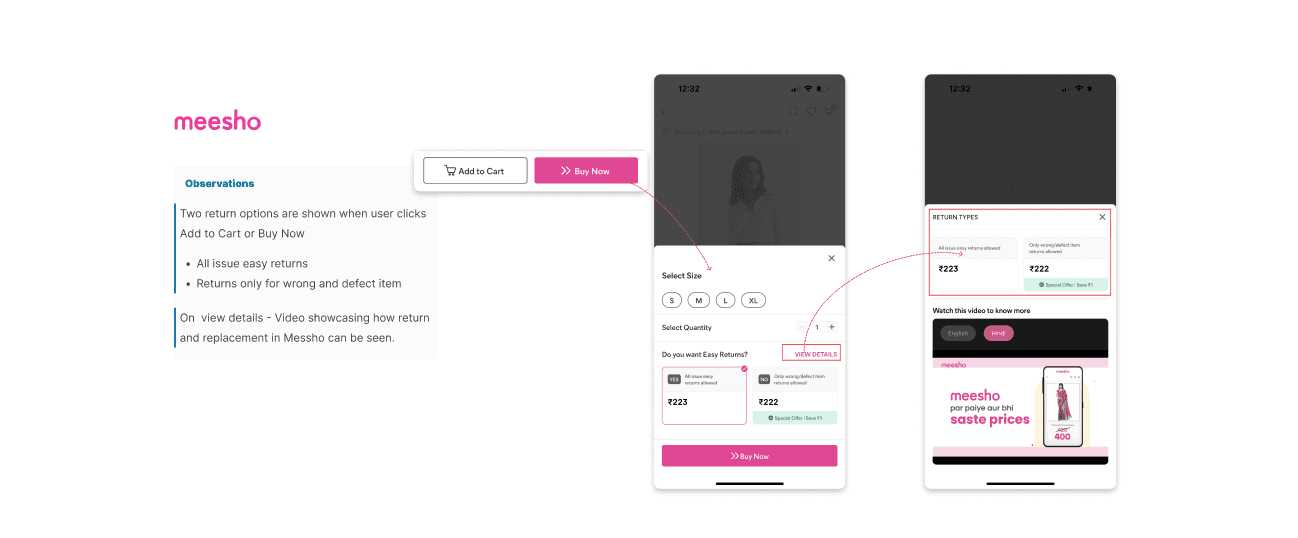
COMPETITOR AUDIT - What WE BENCHMARKED
Platform
Return visibiity
STATUS TRACking
LANGUAGE CLARITY
Flipkart
Prominent
Step - by - step
Clean
Myntra
Moderate
Basic updates
Moderate
Ajio
Buried
Minimal
Confusing
Amazon India
(before)
Moderate
Opaque
Confusing
THE MOMENT THAT CHANGED THE DIRECTION
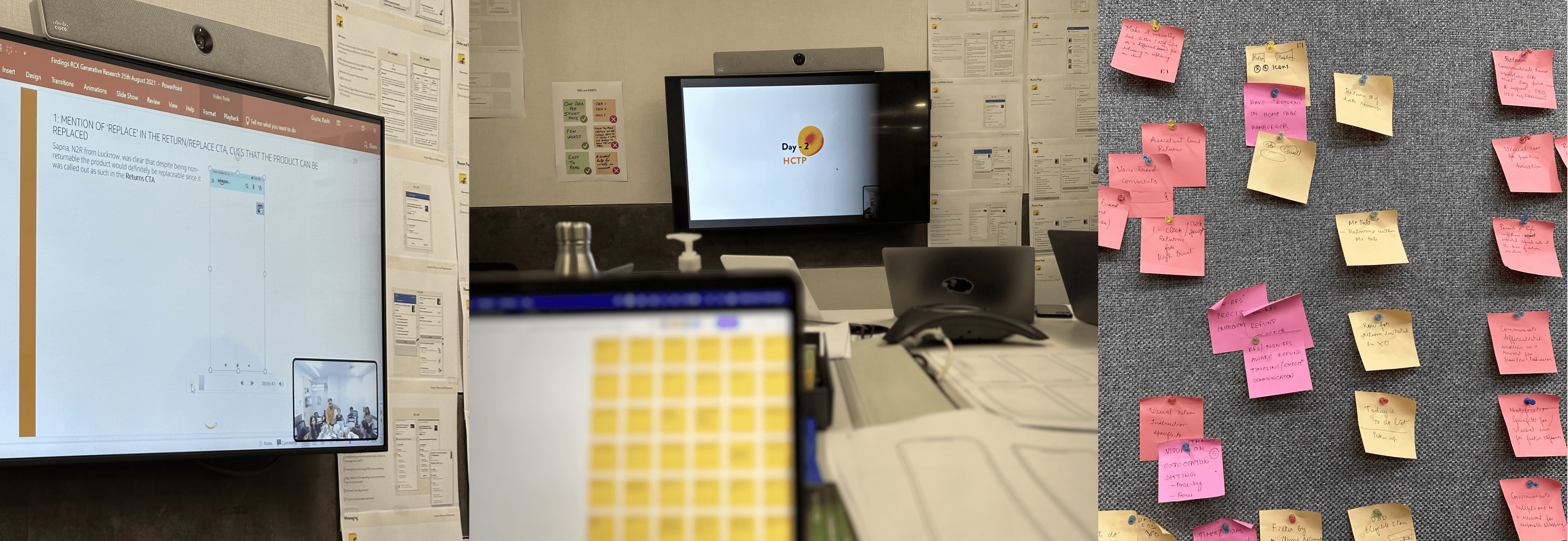
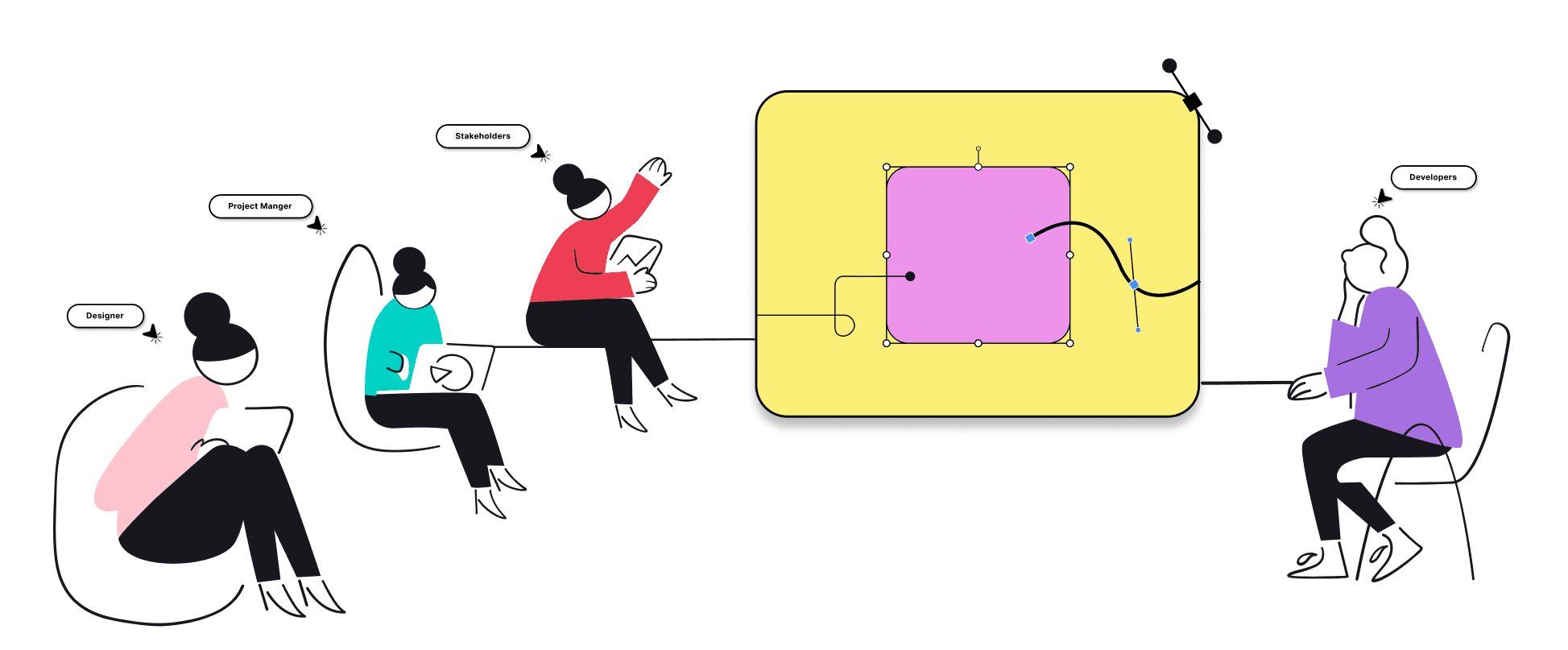
On Day 2, we stopped listing features and
The FigJam board was full of pain points. But the patterns were not in the features.
They were in the emotions, frustration, distrust, helplessness. Users did not want a better return button. They wanted to feel like Amazon was on their side.
That single shift from interface to trust shaped every solution that followed.
DAY 3: FROM CHAOS TO DIRECTION
20 people generated 80+ ideas.
We dropped most of them
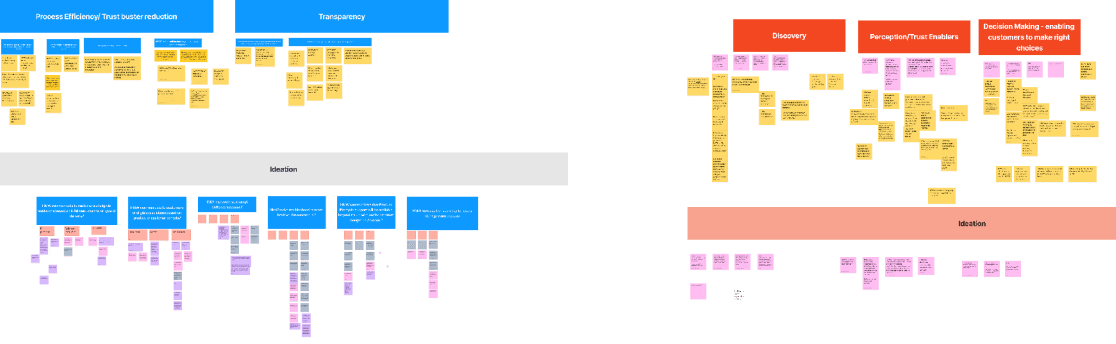
Through How Might We questions, affinity mapping, and Crazy 8s, the room went from chaos to three clear directions. But what we cut was just as important as what survived.
WHAT SURVIVED → WHY
Accessible navigation
Users could not find returns on the product page. Highest pain, lowest engineering cost.
Plain language policy
Terminology confusion appeared in every single research session.
Real-time status tracking
The status void was the #1 driver of support tickets.
WHAT WE DROPPED → WHY
Sustainability messaging
Important but out of scope for a 5-day sprint. Needed supply chain involvement.
Fraud detection overhaul
Required deep engineering investment we did not have in the sprint window.
Full ORC redesign
Too large. We scoped down to the return specific touchpoints where trust was breaking.
What the room produced
How might we simplify, speed up, and expand the return process while promoting
self-repair and service center replacements, and eliminating fraudulent returns or replacements?

DAY 4 & 5: DESIGN DIRECTION
We prototyped three directions in 24 hours.
Then tested them with real users.
Decision 01
ACCESSIBLE NAVIGATION
Every path forward is visible before the user chooses.
Return it. Replace it. Exchange it. Get it repaired. Visit a service center. Fix it yourself with brand support.
Before the sprint, users had to discover these options by trial and error. We designed a system where every available path appears the moment you open your order, with step-by-step instructions, pickup details, and timelines. The user never has to ask 'what do I do now?'"
This prototype showcases a phone replacement request, a high-value case routed to a human agent for faster resolution.
It represents one of several use cases explored during the sprint; others are under NDA.
Decision 02
PLAIN LANGUAGE POLICY
Replaced technical terms with plain descriptions.
Turned 'Order Return and Cancellation' into a clear Replacement / Exchange / Refund tab system.
Replacement
Exchange
Refund
Each policy shown in a table: Reason → Period → Policy. Step-by-step instructions with numbered icons. Tested with Tier 2 users who had never initiated a return before.
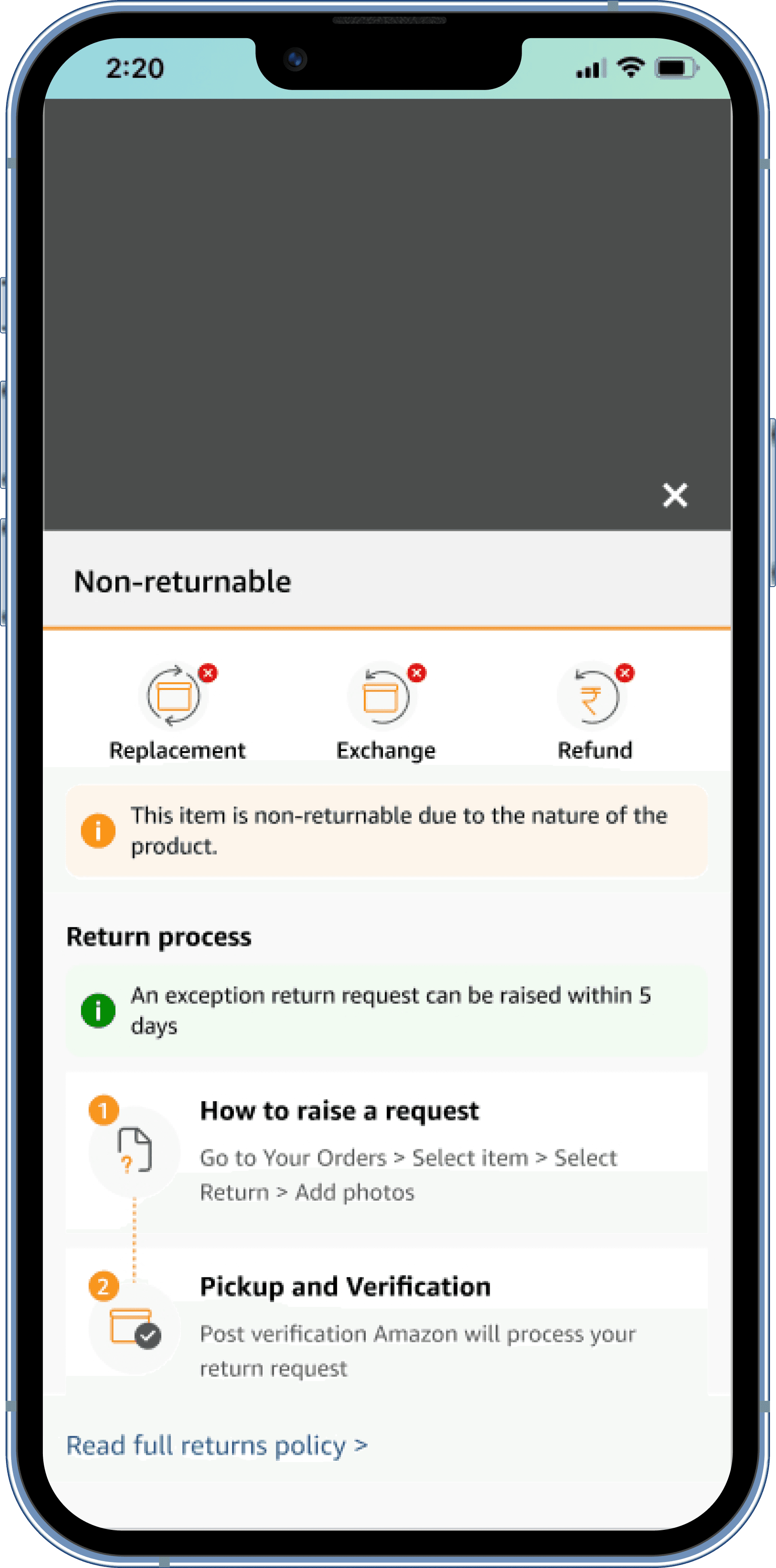
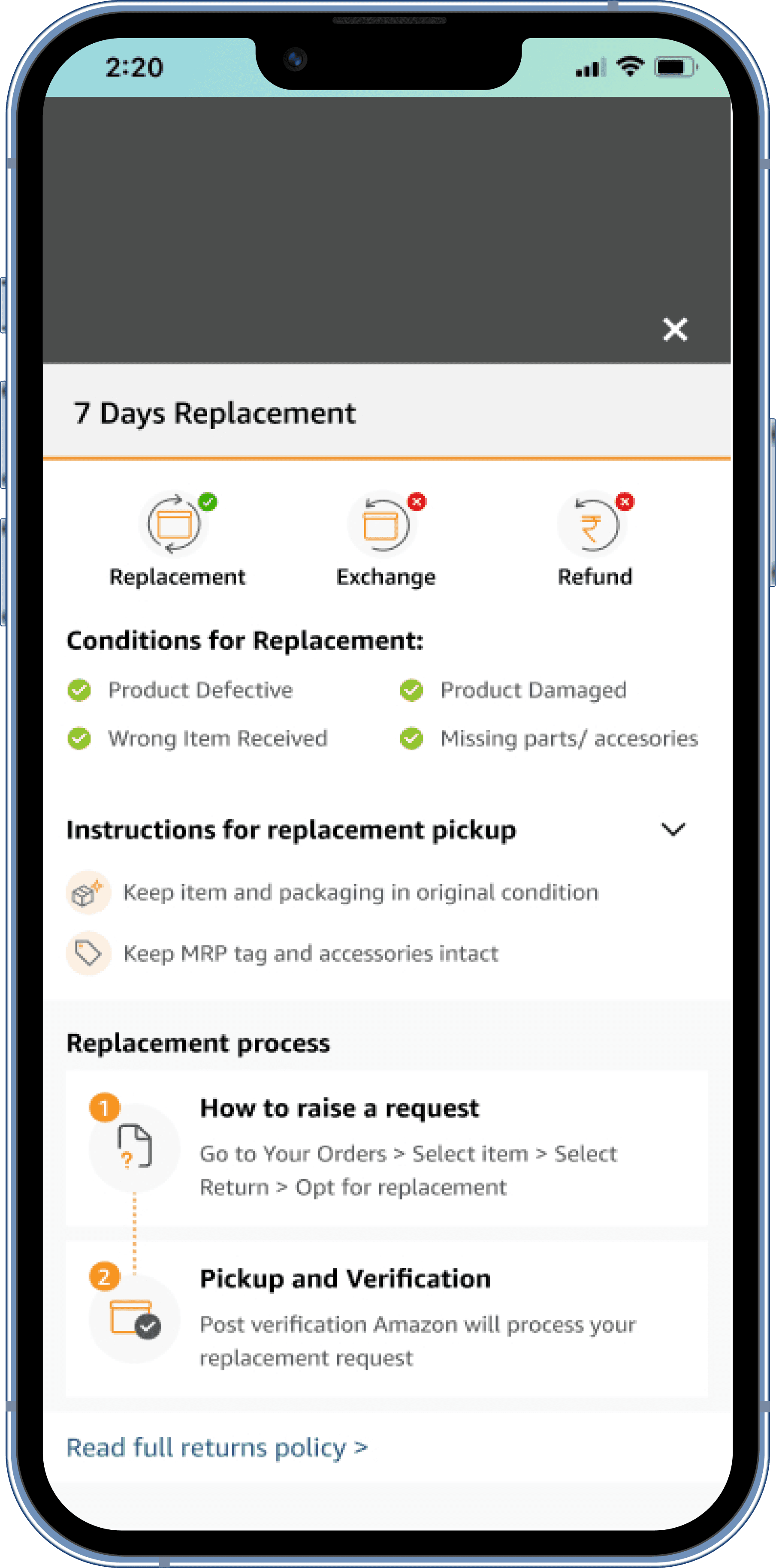
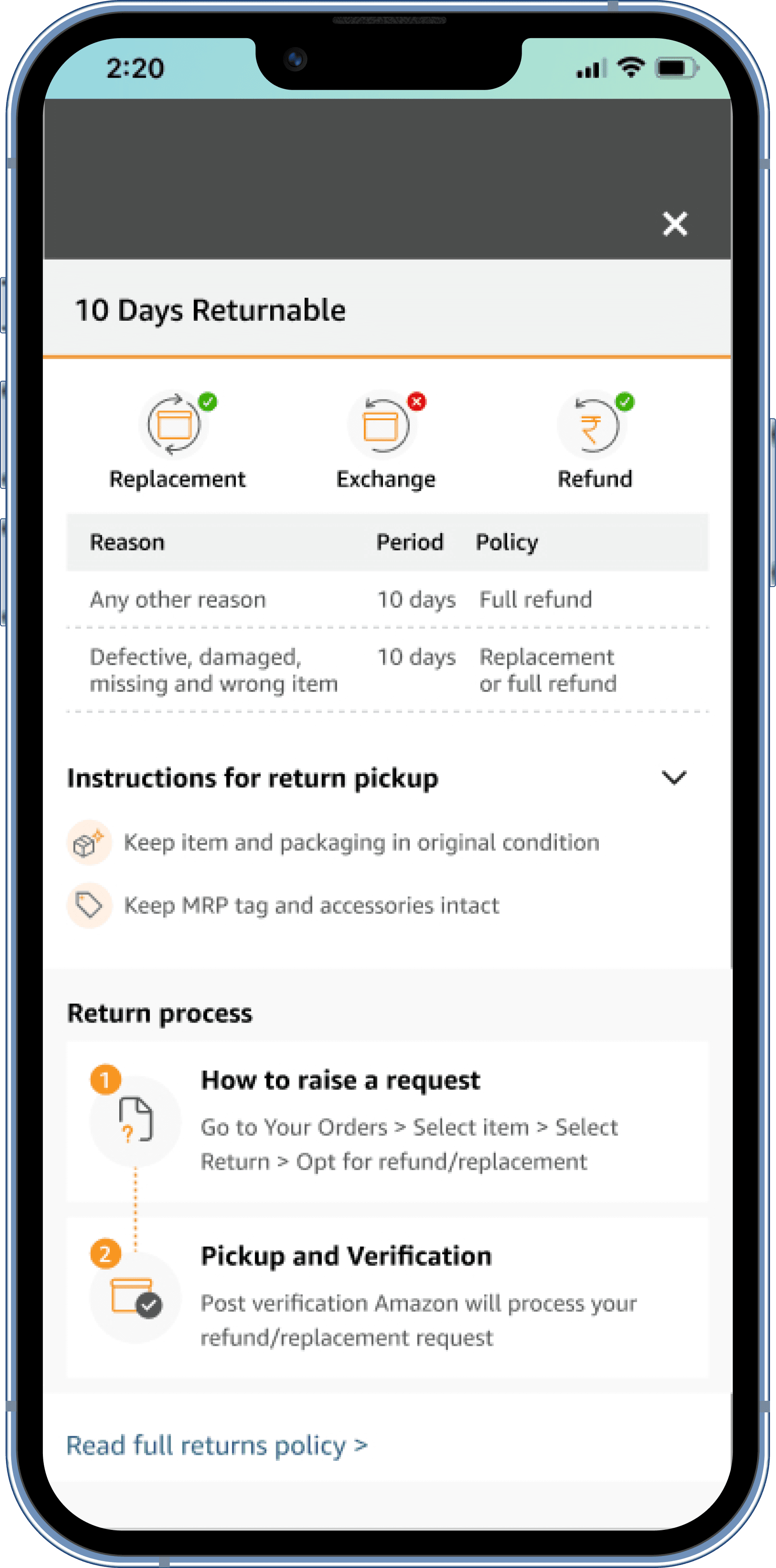
This prototype showcases a phone Order Return and Cancellation policy.
It represents one of several use cases explored during the sprint; others are under NDA.
Decision 03
REAL - TIME STATUS TRACKING
Users said status tracking alone changed how safe the process felt.
Designed inline status updates visible directly in the orders list. Every stage like pickup, delivery, installation, refund, shows up without tapping into the order. No hunting. Status comes to the user.
Value tags
Blue tags show delivery promises
Update Tag
Green tags show post-delivery updates
Users know what to expect before delivery and what happened after.
Arriving Today
Out for delivery
TCL 80.04 cm (32 inches) Bazel...
Out for Delivery
Your order will be delivered by 10 PM today
TCL 80.04 cm (32 inches) Bazel...
Installation Scheduled
Our technician will arrive tomorrow
TCL 80.04 cm (32 inches) Bazel...
Delivered on Fri, 24 May 2023
Return by 2 July 2023
Same day delivery
Open Box Delivery
TCL 80.04 cm (32 inches) Bazel...
Delivered on Fri, 24 May 2023
Return by 2 July 2023
Same day delivery
Installation Completed
₹
Refund Initiated
Your refund of ₹700.00 has been initiated

GHROYAL Solid Sheesham Wo...
Return Initiated
Our delivery agent will arrive for pickup tomorrow
GHROYAL Solid Sheesham Wo...
On Time
Return Requested
Return pick up will be scheduled soon
GHROYAL Solid Sheesham Wo...
TCL 80.04 cm (32 inches) Bazel...
Delivered on Fri, 24 May 2023
Return by 2 July 2023
Delivered on Time
TCL 80.04 cm (32 inches) Bazel...
Delivered on Fri, 24 May 2023
Return by 2 July 2023
Delivered in 1 day
Device set up at delivery
Replacement Completed

Amazon Brand - Symbol Men...
Delivered on Fri, 02 Jun 2023
Replaced within 1 day
₹
Refund Completed
Your refund of ₹700.00 has been credited
Amazon Brand - Symbol Men...
Refund processed within 24 hrs
₹
Refund Completed
Your refund of ₹700.00 has been credited
GHROYAL Solid Sheesham Wo...
Refund processed within 24 hrs
Decision 04
REDUCING RETURNS AT THE SOURCE
Reduce returns by rewarding better choices.
Most platforms handle return fraud by restricting access making returns harder for everyone.
We designed the opposite. Smart Shopper rewards users who make thoughtful purchases with
Extra Savings, Free Returns, and Faster Refunds. Low return rates unlock benefits.
The incentive shifts from "return less or else" to "shop well and we'll take care of you."
Ownership
Team decision - I contributed to the concept and designed screens
STATUS
Prototyped and tested during the sprint
Rewards integrated directly into Your Orders Page.
Smart Shopper banner appears inline, users see benefits alongside their order history.
WHAT WE VALIDATED
We tested with real users on Day 5.
They found the return button faster. They understood what 'replacement' meant. They trusted the status update when it appeared.
Faster
users found the return path in usability testing
Clearer
users could explain the process back to us
Trusted
users said status tracking made them feel in control
The biggest shift wasn't the UI. It was the language. When we stopped writing policy and started writing for a person who just wanted their money back everything clicked.
WHAT I TOOK FROM IT
Facilitating is a different skill to designing.
You have to hold a room of 20 people without controlling it. Know when a bad idea is worth exploring and when it needs to die quickly. That tension between facilitation and design is where I learned the most.
The most important moment was Day 2, when we stopped listing features and started mapping feelings. Users did not want a better return button. They wanted to feel like Amazon was on their side.
Facilitation insight
A room of 20 people needs structure, not control. The best ideas came from the quietest people but only after the loudest ones had been heard.
Design insight
Trust is not a feature. It is the cumulative effect of every small decision, language, timing, and honesty about status.
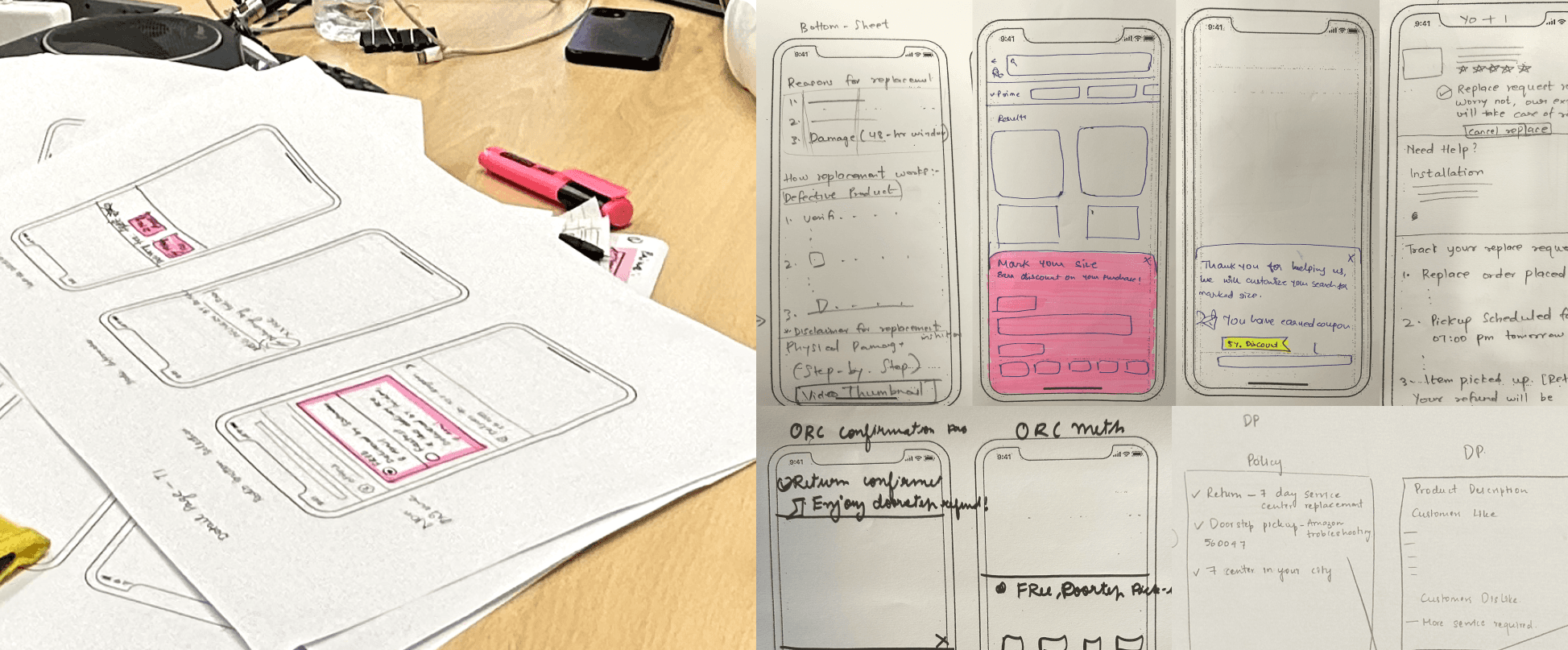
This project is under NDA.
What you have seen is what I can share.
Want to talk about the sprint process?
Mail @
Copy component
Copied
aishwarryabp07@gmail.com
Thanks for scrolling.
Let's design something
worth coming back to.
Open to full-time product design roles.
Also happy to talk ideas, design systems, or anything in between.
Mail @
Copy component
Copied
aishwarryabp07@gmail.com
Resume
Resume
Aish.